Turmeric FPOs face the same crunch almost every season: arrivals peak, farmers need cash, and prices feel weak right when most of the crop hits the market. Recent public mandi references, including Nizamabad and other turmeric markets, have shown harvest-time prices mostly in a lower band, with average spot references around ₹12,000–₹15,000 per quintal depending on date, location, and grade.
At the same time, public futures quotes in late May 2026 have shown near turmeric contracts around ₹16,000–₹16,300 per quintal, which naturally makes FPOs wonder: “If the derivatives market price is higher, shouldn’t we just hold stock, hedge it, and earn more?”
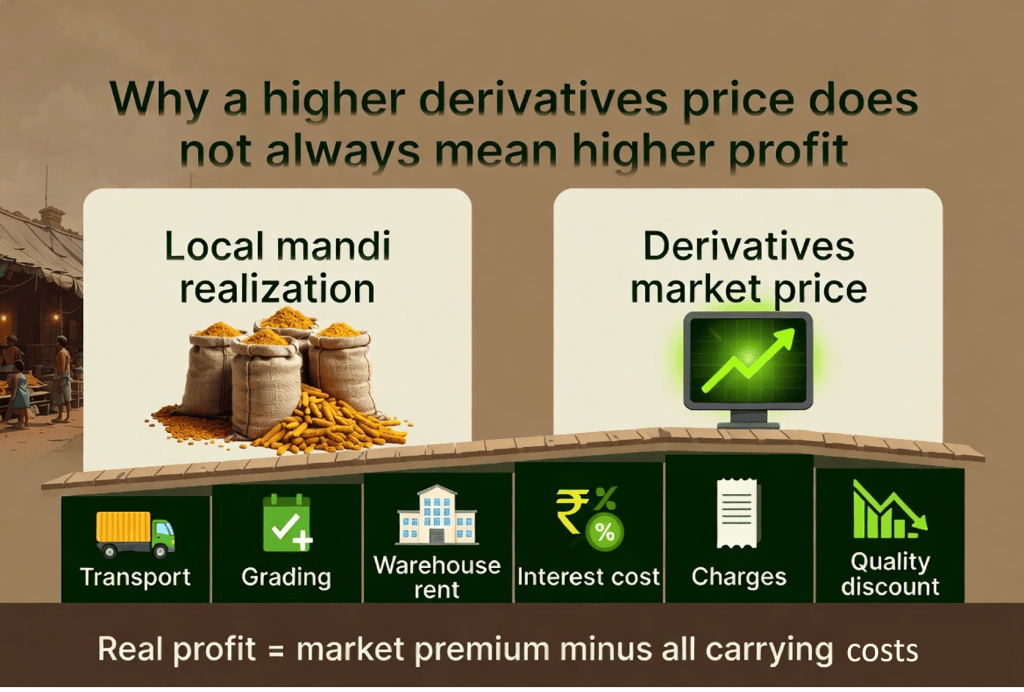
The problem is that the gap between mandi and derivatives prices is not pure profit. It is only the starting point. Between the mandi and the derivatives market sit all your real-world costs: transport, grading, storage, interest, charges, and quality risks.
Why this matters right now
This season is a good example of why “futures are higher” is not enough. Public reports earlier in the year showed turmeric futures under pressure when fresh arrivals hit, including an April futures quote around ₹14,422 per quintal in March 2026, before later strengthening in May.
That tells us two things. First, spot and futures can move differently over time. Second, a simple “hold and wait” approach can backfire if the FPO is not watching basis (the difference between local spot realization and futures) and its own cost of carry.
So the right question for a turmeric FPO isn’t “Will prices go up or down?” It’s “Can we build a system where farmers don’t have to panic-sell, and we still keep some room for upside?”
Start with protection, not prediction
For most turmeric FPOs, the safest first step into the derivatives market is downside protection, not aggressive futures trading. Public information on FPO support schemes shows that put options have been used to give FPOs a floor price, sometimes with premium support, especially in crops like turmeric, jeera, and dhaniya.
A put option behaves a bit like price insurance. If market prices fall below a certain level, the option increases in value and helps cushion the lower physical price. If prices rise, the FPO can still benefit from the stronger mandi or processor rates, subject to the premium paid and the contract’s terms.
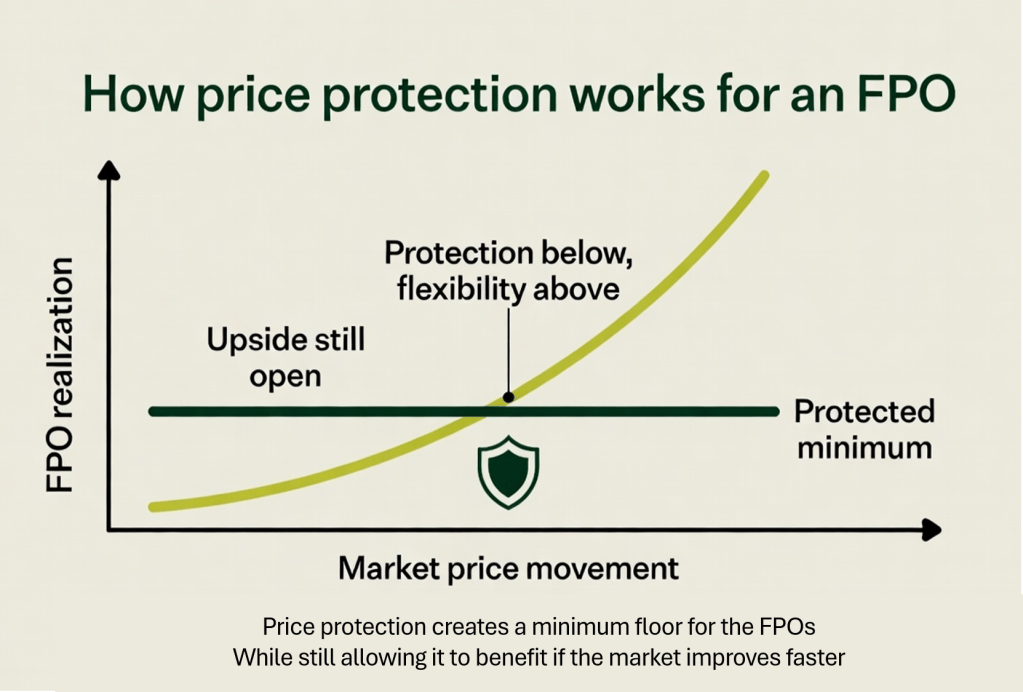
This is exactly what many FPOs need during arrival season. Their primary job is to protect member incomes from distress selling and improve the average realization, not to become traders trying to time the market perfectly. In that sense, protection tools like put options are usually more forgiving than futures for a first layer of risk management.
Where futures actually fit
Futures still have an important role, but they need more structure. Turmeric futures contracts are standardized (5 MT lots) and carry margin requirements around 12 percent, which means any FPO using them needs clear stock visibility, treasury discipline, and the ability to handle daily mark-to-market swings.
That’s why futures work best when three conditions are met at the same time:
- The FPO has already procured real, graded stock.
- It has storage and funding capacity to hold that stock.
- The gap between local spot realization and futures is big enough to cover all carrying costs.
When these conditions are missing, futures can create stress rather than value. An FPO can be right about the long-term market direction and still lose money due to basis risk, quality discounts, interest costs, and operational slippages.
The real calculation: net, not gross
This is where many marketing decisions go wrong. The most visible number is the price on the mandi board or the price on the derivatives screen. But neither one is the final number that reaches farmer members.
The actual decision should be based on net realization, which means:
- Collection and aggregation cost.
- Cleaning, sorting, grading, boiling/polishing if applicable, and packing.
- Transport to warehouse or buyer.
- Warehouse rent and handling.
- Assaying and any quality-related deductions.
- Interest on working capital during the holding period.
- Exchange transaction charges, brokerage, and statutory costs.
- Margin funding cost for futures positions.
- Moisture loss, shrinkage, and quality deterioration in storage.
If the derivatives-market premium does not comfortably cover all these costs, forcing a “carry trade” just to look sophisticated can actually reduce farmer income. In those cases, a protected, timely sale is smarter than a delayed one.
A simple framework an FPO can follow
The good news: you don’t need a complex model to get this right. A simple, disciplined framework is enough.
Think of your turmeric FPO’s strategy in four steps:
- Protect the core: Use put options (where available and affordable) on a significant share of expected procurement to create a floor.
- Use futures selectively: Use futures primarily against actual physical inventory, not as a standalone “view” on prices.
- Keep some volume flexible: Leave a portion unhedged to sell into sudden mandi or processor strength, especially where the local buyer’s net price beats the derivatives-linked route.
- Track basis and costs daily: Always compare “what we get in the mandi or from a buyer” vs “what we’d get via a derivatives-linked sale” after costs, not before.
This way, protection tools reduce the risk of distress selling, while selective futures and good physical marketing give the FPO room to improve the season’s average price.
Decision table for everyday use
You can use this table inside the blog and also as an internal checklist.
| Situation | What it usually means | Sensible FPO response |
|---|---|---|
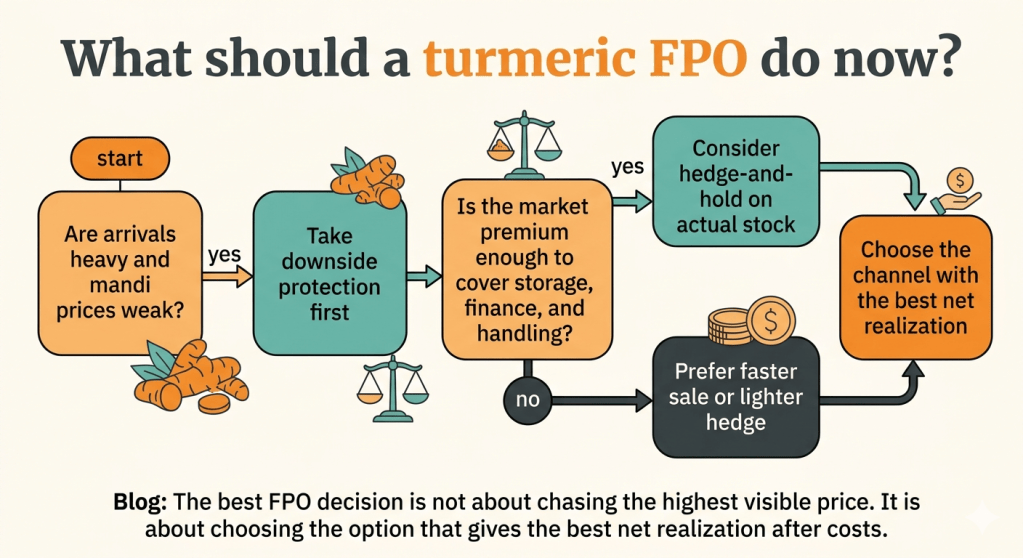
| Arrivals are heavy and mandi prices are weak | Downside risk is high. | Focus first on downside protection (e.g., put options where accessible). |
| Derivatives market price is clearly above local spot | A carry opportunity may exist, but only after costs. | Consider hedge-and-hold only if storage, finance, and quality economics are favorable. |
| Spot and derivatives prices are almost equal | The gross spread is too thin. | Prefer faster sale or a lighter hedge instead of forcing a carry trade. |
| Local buyer offers better net price than derivatives-linked route | Basis is favorable in the physical market. | Choose the better physical outlet; treat derivatives as support, not the main channel. |
| Prices recover after you have taken protection | Floor protected your downside; upside is still available. | Sell in tranches to improve average realization. |
| Prices fall sharply after harvest | Distress selling pressure increases. | Use the protection benefit to cushion sales and avoid panic disposal. |
Illustration 3 (FPO decision flowchart)
What really improves earnings
The biggest takeaway for turmeric FPOs is that derivatives alone do not create value. They help unlock value when combined with better physical marketing.
That means:
- Aggregating more systematically.
- Improving grading and standardizing lots.
- Using storage only when the economics justify it.
- Building direct links with processors, exporters, and institutional buyers.
Studies on the turmeric value chain make this clear: storage infrastructure, testing facilities, training, and stronger linkages often add more to farmer income than any single trade in the derivatives market.
The derivatives market, then, should be seen as a support system. It gives your FPO time and flexibility to execute a smarter physical marketing plan, instead of being forced to sell everything immediately at whatever price the mandi offers on the day.
Closing thought
For a turmeric FPO, the derivatives market is not a shortcut to higher prices. It is a tool that, when used carefully, can reduce downside risk and give you more control over when and how you sell.
The real shift is this: you move from selling under pressure to selling with a plan.
Disclaimer: The views, analysis, and commentary in this post are my own and are intended for educational and informational purposes only. They do not constitute financial, investment, legal, or trading advice, and should not be relied upon as such. Price references cited in this post (including mandi spot prices and futures quotes) are drawn from publicly available sources at the time of writing and may not reflect current market conditions. Commodity prices are inherently volatile and can change rapidly. Farmer Producer Organizations (FPOs), their members, and any other readers should independently verify all information and consult qualified professionals — including commodity market advisors, agribusiness consultants, or legal experts — before making any procurement, hedging, or trading decisions.


Leave a Reply