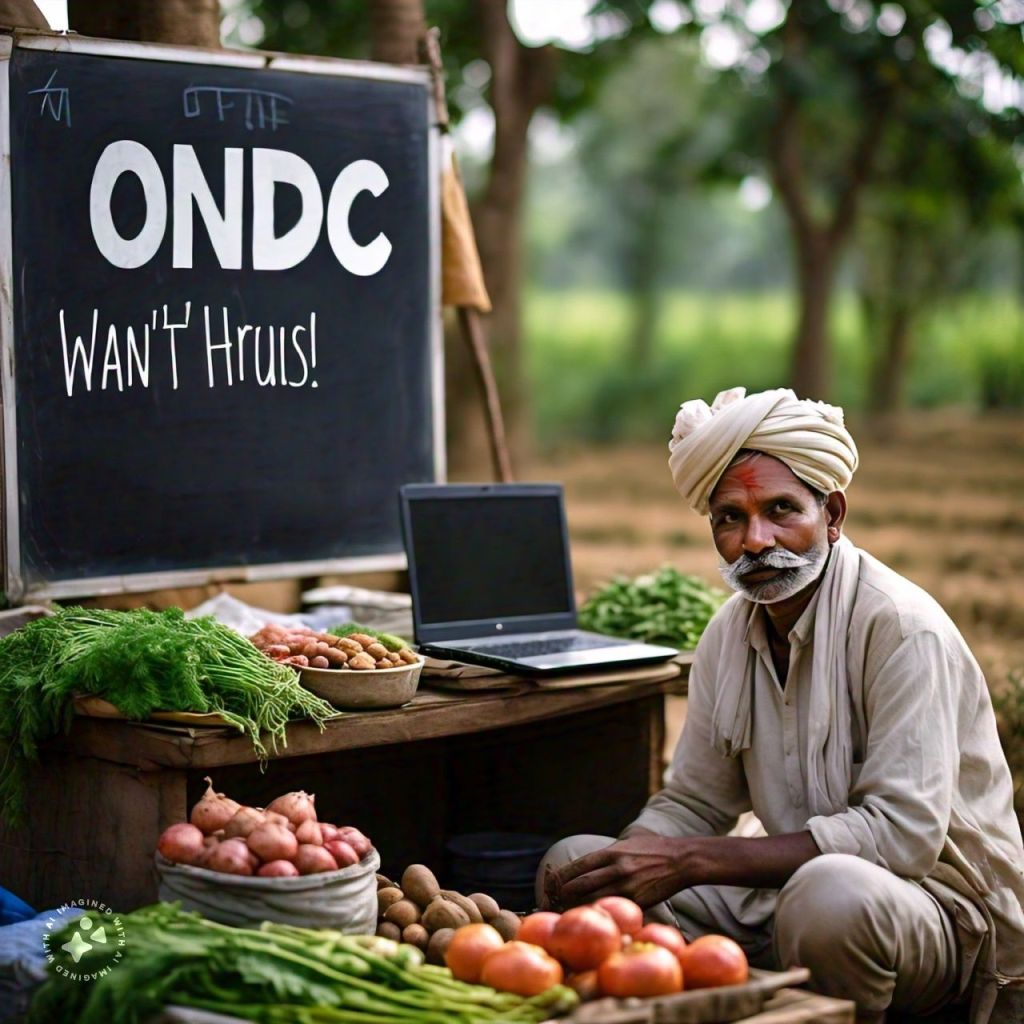
The previous blog post tried to explain the ONDC phenomenon and its utility for FPOs. This blog post explores the key challenges faced by FPOs on ONDC, drawing insights from real-world FPO experiences
The Indian government is making significant efforts to ensure that Farmer Producer Organizations (FPOs) are successfully on boarded onto the Open Network for Digital Commerce (ONDC). Organizations like the Small Farmers Agribusiness Consortium (SFAC) and NABARD are working tirelessly to support this initiative, even promoting FPO products through their websites and social media channels. However, many FPOs still experience unease when using the portal.
The financial success of most businesses hinges on achieving scale. Even with profit margins of 70 to 80%, selling only 50 to 100 units does not ensure sustainability. Scaling up helps reduce costs by optimizing business activities, which requires time, effort, financial capital, and, most importantly, a clear vision. Therefore, it is essential to ensure that all necessary support is provided to farmers venturing into business. Here, we delve into some of the issues and challenges faced by FPOs when engaging in new business ventures. Policymakers and supporting agencies can address these challenges.
Challenges Faced by Farmer Producer Organisations on ONDC
1. Awareness About the Platform and e-Commerce : Although approximately 5,000 FPOs have been on boarded onto the ONDC platform, only a small number have started selling their produce regularly. This is largely due to a lack of awareness among buyers.
“Jai Sardar FPC and Krushi Vikas Gramin Prashikshan Sanstha, Maharashtra, reported that the number of buyers on ONDC is currently lower compared to other e-commerce platforms. This limits regular and bulk demand for their agricultural commodities.”
2.Lack of Online Business Knowledge and Staff : Running an online business involves various standard operating procedures (SOPs) such as cataloguing, correct labeling, inventory planning, and declaring stock outs. These processes need to be communicated clearly to FPO leaders, who are primarily farmers with little to no business experience. Many FPOs lack trained manpower to handle these activities.
“Growpure FPC, Betul, Madhya Pradesh, registered on ONDC in January 2024 but has only managed to sell 1 kg of turmeric powder to a buyer in Bengaluru. The FPO cited the need for intensive training and a proper understanding of the entire process, including labeling, catalog preparation, and specific product information. They lack the necessary technical knowledge, skilled personnel, and guidance.”
“Nimad Fresh FPC, Khargone, Madhya Pradesh, has been onboarded on ONDC for two months. Although they have branded products, they report that running a successful ONDC operation requires a dedicated resource person and sufficient funds to maintain product stocks.”
3.Quality Standards and Certification: Online grocery businesses are highly regulated, requiring licenses such as FSSAI and Weights and Measures. Maintaining quality standards and achieving standardization across batches is challenging without trained manpower and infrastructure.
“Satpudanchal FPC and Unnatisheel FPC, Betul, highlight the difficulty in ensuring compliance with quality standards and certifications necessary for selling agricultural products online. FPOs struggle with the necessary resources and knowledge for primary processing and infrastructure, making it hard to prepare stock for online sales.”*
4. Logistics, Return Policies, and Payments : Managing logistics for shipping products from interior locations can be difficult and costly. Payment terms are often unclear, leading to skepticism about timely payments. Additionally, handling returns is challenging due to the costs and complexities involved.
“Madhya Bharat Consortium of FPC, Bhopal, states that FPOs often face logistical challenges, especially when shipping to distant locations.”
“Jatara Mahila FPC, Tikamgarh, which listed Mustard Oil and Chana Dal on ONDC, sold only 150 liters of Mustard oil. They find the payment terms and conditions skeptical and time-consuming, with payments received 15-20 days after sales. The redressal mechanism for returns is also unclear and time-consuming.”
Author’s Take
ONDC offers a significant advantage with its low commission costs. However, there are following primary issues:
- Limited consumer awareness of the ONDC network and its buyer apps.
- Inadequate promotion of FPO brands within the seller apps
- High logistics costs for FPOs.
- Little knowledge about Food Safety Standards by the FPOs
In the era of digital marketing, even small brands spend 15-24% of their budget on marketing, amounting to 5 to 10 lakhs annually. They employ professionals and third-party services for promotion. ONDC, as an open network, cannot promote itself or any product. Participants must promote themselves, and while large brands are already well-known, smaller FPOs lack this support. Although seller apps can promote FPO brands, their efforts may be limited without sufficient capital.
Logistics costs borne by consumers can be significant. Most online delivery brands struggle with high delivery costs despite their scale. Helping FPOs manage these costs is crucial.
Operating an online business involves complex processes that require time and planning. Drawing from experience in retail, even established companies take months to set up efficient online operations. FPOs, however, often rush these processes, leading to subpar execution.
What about Food safety Regulations ?
Food safety regulations govern various qualitative aspects of food products.
Let’s discuss the basic labeling regulations. Any food product that is “packed and sealed” must comply with labeling requirements such as providing general information, nutritional information, additive information, and a veg/non-veg symbol, among others. (For more details, refer to the FSSAI document on this topic.) The FSSAI strictly monitors compliance with these regulations.
I recall an incident during my time working at Big Bazaar when a food officer visited one of the retail stores and imposed a penalty. The item in question was a pack of fresh strawberries, which, like many products we buy from the market, did not have any label or veg/non-veg symbol. Although the penalty was reversed since the packaging was a flip-open box rather than a sealed one, the officer found other products, such as mushroom packs and packed vegetables, that did not meet the labeling requirements. This led the company to decide to stop selling any product without proper labels and to require vendors to send only compliant items. Therefore, as mentioned earlier, organized retail takes extra time and care when it comes to selling products that fall under labeling regulations.Same is true for online selling catalouging is very important.
Now, regarding the products of FPOs (Farmer Producer Organizations) being sold on the ONDC (Open Network for Digital Commerce) network, there are many products being displayed without fulfilling labeling requirements. It is likely that many FPOs are unaware of the regulations or have displayed products in haste. For most FPOs, obtaining the FSSAI license is considered the end of the task. However, this could become a problem in the future if the FSSAI decides to audit.That said, there are also, products from FPOs themselves that can be deemed safe as per the regulations.
So, how are some FPOs complying with the rules? Upon further investigation, it was found that in most cases, the FPOs in question are well-established, and in other cases, Cluster Based Business Organizations (CBBOs) are helping their associated FPOs manage the process.
For example, an NGO called Krushi Vikas from Buldana, Maharashtra, which is also a CBBO under the FPO scheme, is helping its tribal FPOs from Chandarpur district in marketing spice products and managing their operations on the ONDC network’s MyStore App.Recently came across products from Kirmaniya Fed FPC from J&K,in Mystore App,they had listed carefully curated packaged products and they are supported by ISAP India Foundation.
Navigating Challenges
Already a lot of training and “capacity building “efforts are on but reflecting on my years of experience closely observing capacity building efforts for FPO empowerment, business-as-usual approach to programs like ONDC or eNAM will only yield more protracted training with meager results. The time for incremental change has passed – to truly unlock the potential of these digital platforms, the government must be willing to radically rethink resource allocation. Some of the Approach ideas listed below can be tried
A. Direct Formal Support
Skill Development:
- Facilitate workshops on branding and marketing strategies specifically tailored to the FPO sector, emphasizing storytelling and highlighting the unique value proposition of FPO products
Financial Runway:
- Allocate a portion of FPO welfare funds to subsidize the costs of e-commerce platform marketing and branding efforts.
- Government grants or microloans to help FPOs invest in technology and infrastructure needed for smooth online operations.
Logistics Support:
- Collaborate with logistics providers to offer FPOs competitive shipping rates, particularly for deliveries originating from rural locations.
- Conduct training sessions on packaging and product handling best practices to minimize damage and ensure product quality during transportation.
B. Innovative Support
Virtual Mentorship Network: Partner with e-commerce experts. Imagine a platform where FPOs can connect with mentors for personalized guidance on online business strategies
Data-Driven Decisions: Equip FPOs with data analytics tools to understand consumer behavior on ONDC. This could help them optimize product offerings and pricing for better reach and sales.
Tech-Savvy Training : Online courses and workshops are great, but what if we gamified e-commerce training specifically for FPO leaders? Imagine a mobile app where they can learn cataloging, quality control, and customer service through interactive challenges.
Crowd sourcing Platforms : Imagine a crowdsourcing platform where designers and marketing professionals volunteer their expertise to create compelling FPO brands for ONDC
CBBOs as Partners : CBBOs which are already working with large number of FPOs can be planned to act as busuiness partners and not just a capacity builder.
Call To Action
The vision of empowered FPOs thriving in the digital economy is an admirable one, but achieving it will require a fundamental shift in mindset and approach. Rather than simply funneling more funds into the same cyclical programs, policymakers should prioritize bold, outside-the-box solutions. The role of CBBOs is very important in capacity building Even enlisting India’s best strategic consulting minds to co-create novel go-to-market strategies could breathe new life into these initiatives.
Read More Blogs Here…
How Turmeric FPOs Can Think About Price Risk in a Spot and Futures Market
Turmeric FPOs face the same crunch almost every season: arrivals peak, farmers need cash, and prices feel weak right when most of the crop hits the market. Recent public mandi references, including Nizamabad and other turmeric markets, have shown…
Digital Bharat, Digital Kisan
How Technology Can Rewrite the FPO Playbook Indian agriculture has entered a new phase. Union Budgets are no longer only about MSP and subsidies—they now emphasize AI platforms, digital public infrastructure (DPI), and data‑driven decision-making. For Farmer Producer…
ओएनडीसी नेटवर्क : एफपीओ के लिए डिजिटल बाजार
ONDC एक डिजिटल बाजार है जो किसानों और विक्रेताओं को सीधे जोड़ता है। इसमें कमीशन का बोझ नहीं है और छोटे और बड़े सभी खिलाड़ी आजादी से प्रतिस्पर्धा कर सकते हैं। ONDC FPOs के लिए एक अच्छा विकल्प हो…
Something went wrong. Please refresh the page and/or try again.
 FARM TO EXCHANGE
Leave a comment