Imagine a world where buying and selling online is as seamless as sending a message. That’s precisely what the Open Network for Digital Commerce (ONDC) aims to achieve. Launched by the Government of India in April 2022, ONDC is set to revolutionize e-commerce by creating a common platform where different online stores and payment systems can interact effortlessly. Think of it as the UPI of e-commerce—just like how you can use any UPI app to pay with a QR code, ONDC allows various e-commerce players to work together smoothly. Intrigued? Let’s dive in!
So, what exactly is ONDC, you ask? Think of it as a grand, open platform where buyers and sellers can connect seamlessly, bypassing the traditional barriers and monopolies of closed e-commerce giants. It’s a level playing field, a true democracy in the digital marketplace, where even small players like FPOs can thrive and reach a wider audience.
Empowering Farmers/FPOs through ONDC
The ONDC network is a game-changer for farmers and Farmer Producer Organizations (FPOs). By joining ONDC, farmers can finally break free from the shackles of middlemen, access wider markets, and enjoy transparent pricing. This means more money directly in their pockets and a better livelihood. Excited yet? Here’s why FPOs should be jumping on the ONDC bandwagon:
- Access to Wider Markets: Say goodbye to local constraints. With ONDC, farmers can reach buyers from all over the country.
- Reduced Middlemen: No more sharing profits with multiple middlemen. Direct sales mean more earnings for farmers.
- Transparent Pricing: With open access to pricing information, farmers get a fair deal every time.
- Efficient Logistics: Streamlined logistics services ensure that products reach buyers quickly and in good condition.
While the ONDC network offers a seamless platform for selling and buying any kind of agricultural produce, this blog post will specifically highlight the opportunities it presents for FPOs dealing in processed agricultural products.
The Building Blocks of ONDC
So, what makes this all possible? Let’s break down the key components of the ONDC network:
1. Seller App: Seller apps are the backbone for businesses to list products, manage inventory, process orders, and handle logistics. Think of these as digital market stalls. FPOs use apps like Mystore to list and manage their products.
2. Buyer App: These are the apps consumers use to browse and buy products.
3. Logistics Service Providers: These providers ensure your products get from point A to point B efficiently and reliably. They are the unsung heroes making the ONDC ecosystem work.
4. Payment Gateways: These gateways integrate various payment options, making transactions smooth and secure. No more payment woes!
| Seller APP | Buyer App | |
|---|---|---|
| Users | Applications used by businesses and service providers like FPOs | Applications that consumers use to purchase products or services from various sellers on the ONDC network. |
| Interface | Interface provides options like listing, inventory management, handling logistics etc. | Interface provides ability to browse different products and buy from the choices available |
| Examples | In case of FPOs – Mystore seller app Others : Gofrugal, esamudaay | For FPOs- Mystore buyer App. Others : Magicpin, Paytm, etc |
Visual Description of Various Components of ONDC
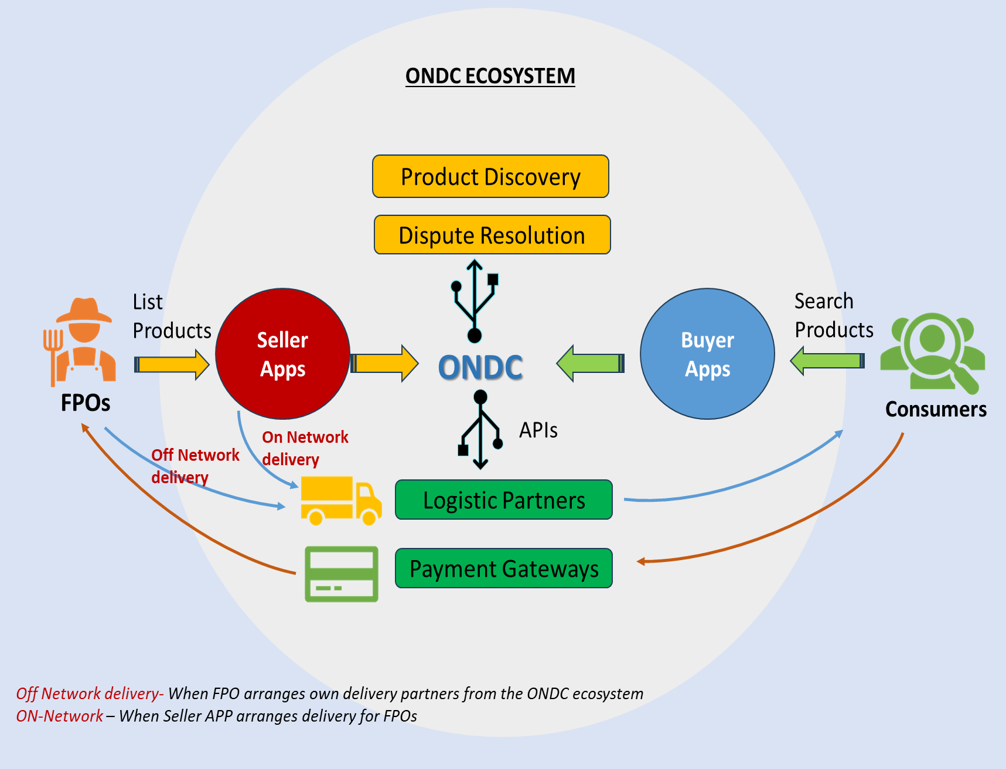
- FPOs list their products on Seller Apps.
- Seller apps are connected to the ONDC network, allowing FPOs to manage their products and reach a wider market.
- At the center, ONDC facilitates the interaction between Seller Apps and Buyer Apps through APIs. It also handles product discovery and dispute resolution
- Consumers use Buyer apps to search for and purchase products listed by various sellers.
- Logistic Partners and Payment Gateways service providers ensure efficient delivery and secure transactions
Addressing FPO Concerns: ONDC vs. Traditional E-commerce Platforms
During a recent interactive session with FPOs facilitated by a implementing agency , it became clear that many FPOs lack understanding of how ONDC differs from platforms like Amazon and Flipkart. Here’s a comparison to clarify:
| Aspect | ONDC | Ecommerce Apps |
| Structure | Open, decentralized network | Closed, centralized platforms |
| Logistics | Multiple service providers can be chosen | Controlled and decided by the platform |
| Customer User App | No dedicated ONDC App, only Buyer’s apps(Mystore, Paytm etc) | Dedicated App |
| Data Availability | Client data available to particular seller | Consumer data not shared with sell ers |
| Commissions | Low commissions for sellers | High commission and other costs apply |
| Promotions | Limited,its still known less | Heavy promotions |
| Data Sharing | Data of client is accessible to buyers and vice versa.FPOs can have data of their buyers | Controlled |
Author’s Take: Success Factors for ONDC
While it’s still premature to evaluate the overall success of such a platform, as its implications are vast and still being identified and explored, certain key factors emerge. Like any other marketplace, ONDC’s success hinges on liquidity, i.e., a high number of participants and technology providers, including a larger pool of logistics players, which tend to reduce transaction costs.
Consider this example: Mystore.com often showcases exciting products from FPOs, but the thrill is overshadowed by exorbitant delivery charges. Imagine the disappointment of finding an incredible deal, only to be deterred by hefty shipping costs. Or take the trust factor—despite cheaper prices on ONDC, many still prefer Zomato for its reliable delivery tracking and established credibility. Check out the price difference yourself by comparing order values.
To make ONDC a resounding success, it must not only offer competitive pricing but also build trust and ensure consistent, high-quality customer experiences. This will encourage more people to embrace the platform, fostering its growth and sustainability.
Readers, keep exploring as our next blog posts will delve deeper into this subject, gaining insights from FPOs’ on-the-ground experiences with ONDC.
READ MORE ARTICLES
Something went wrong. Please refresh the page and/or try again.


Leave a Reply